Types of Meeting Rooms - How to Choose the Ideal Space for Your Meeting

A board meeting, a one-day workshop for 30 people, a short call with a client. Each of these formats requires a different room. Choosing the wrong space can derail even the best-planned agenda. A room that is too small stifles discussion. One that is too large is distracting. The wrong layout blocks interaction.
In short:
Four main types of meeting rooms: boardroom, training, hybrid, and creative.
The choice of room depends on the type of meeting, the number of participants, and the way of working (presentation, discussion, workshop).
In the hourly rental model, you pay only for the time actually used.
Key technical parameters: acoustics, AV equipment, hybrid connectivity, table layout.
What types of meeting rooms are there?
Types of meeting rooms can be reduced to four main types. The boardroom (oval table, for formal decision-making meetings). The training room (classroom or island layout, for workshops and presentations). The video-conference and hybrid meeting room (with full AV equipment and a tracking camera). The creative and brainstorming room (mobile furniture, walls to write on, a free layout). The choice of room type follows from the meeting format, not from its prestige.
Types of rooms differ not only in their furniture. Each supports a different work philosophy. The boardroom says: "we are making a decision". The training room: "we are learning something new". The creative room: "we are inventing". The hybrid room: "we are connecting with those who could not come". The choice comes down to one question. What is actually meant to happen in these two hours?
The boardroom - for formal management meetings
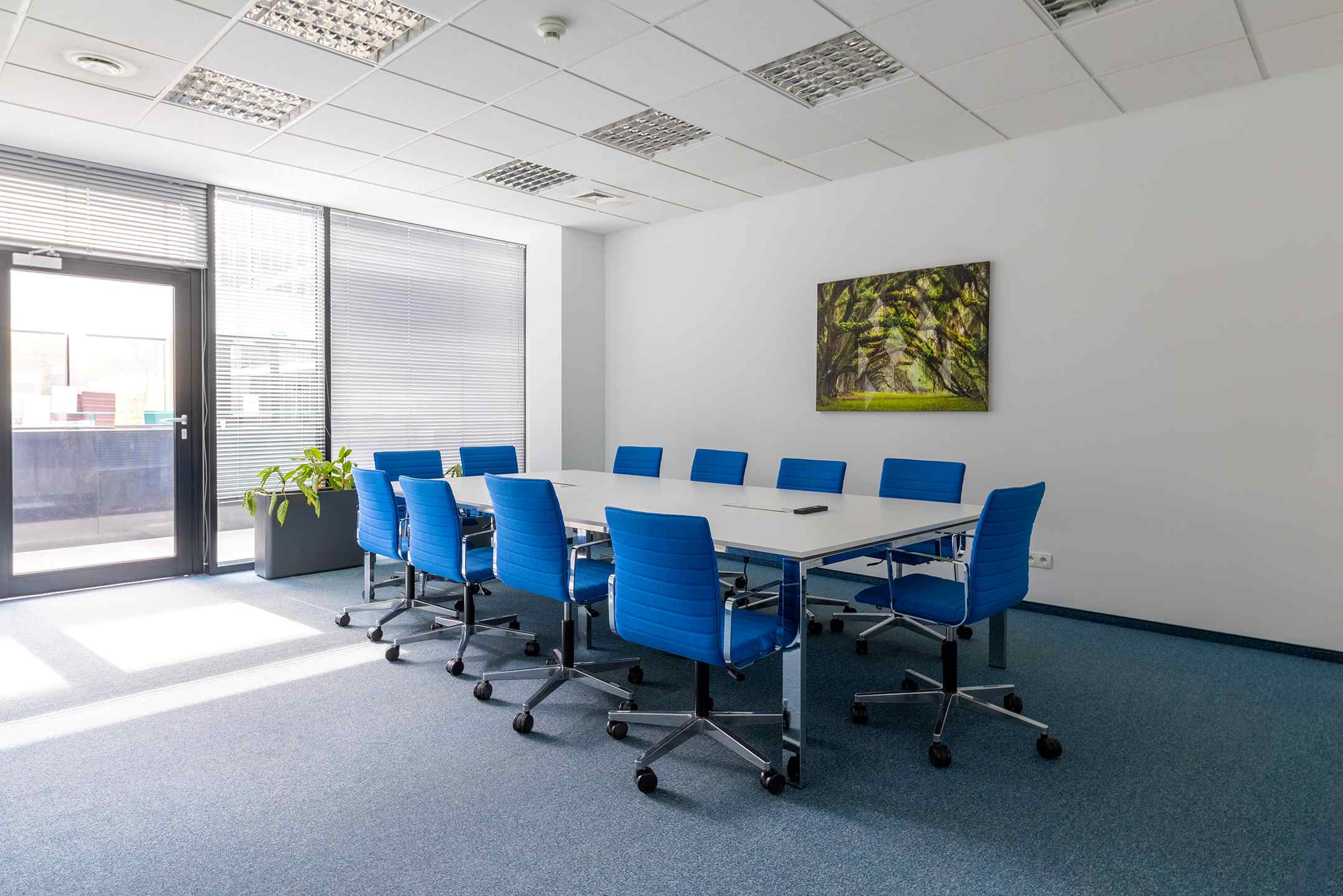
The boardroom is the classic format for board meetings, supervisory board sessions, commercial negotiations, and results presentations. At the centre is a large, oval or rectangular table, around which 8–14 people are seated. On the wall is a large screen for presentations or a video-conferencing system.
The format works when a meeting has a clear hierarchy of roles. There is a host. There is an agenda. There are participants with a specific contribution. Everyone can see each other, and anyone can speak without standing up. A boardroom is usually equipped with high-quality conference microphones, a hands-free system, and blackout blinds.
Crucially, the boardroom does not work for workshops or training sessions. The table is an obstacle when work in smaller groups is required. It is a tool for conversation, not for action.
The training room - for workshops and presentations
Training rooms are the largest category in terms of enquiries. Particularly training rooms in Warsaw, given the concentration of training companies and L&D departments in the capital. Renting a training room is usually a one-off decision: a specific workshop on a specific day.
The most common training room layouts:
Classroom. Rows of tables facing the presenter. Works for presentations and lectures.
Island. Tables in groups of 4–6 people. Ideal for workshops with work in smaller teams.
U-shape. Tables arranged in a U, the presenter in the middle. A format for 12–20 people with high interaction.
Theatre. Only chairs, no tables. Maximises the number of participants (presentations, panel discussions).
A good training room has a flipchart, a projection screen, good acoustics, and mobile furniture allowing the layout to be changed during the day.
The video-conference and hybrid meeting room
The hybrid room is today the standard, not an extravagance. In most business meetings, at least one person joins remotely. From home, from another city, or another country. A video-conference room must handle this in such a way that remote participants do not feel like "second-class" attendees.
Key elements:
A wide-angle camera with auto-framing (tracking the speaker).
Ceiling microphones or conference microphones covering the entire table.
A screen or dual-screen system (one for the presentation, the other for remote participants).
A stable internet connection and a certified Microsoft Teams Rooms, Zoom Rooms, or Google Meet system.
A hybrid room usually costs slightly more than a classic meeting room. However, the difference is recouped in the first run of longer client meetings, in which you do not lose the first ten minutes to the question "can you hear us?".
The creative and brainstorming room
A creative meeting room is more than a room with a sofa and a board. A brainstorming room requires several specific elements. Mobile furniture (tables on wheels, modular seating). Walls you can write on (whiteboards, magnetic walls). Good lighting. Space to move.
The format works for product design, design sessions, Agile team retrospectives, and strategic workshops. Work in such a room assumes that over 3–4 hours participants will move around, write on walls, stick post-it notes, and work in smaller groups.
The opposite of a creative room is a "meeting room with a huge table". The rigid layout blocks the energy needed for an open brainstorm.
How to match the room to the type of meeting?
Choosing a room is choosing a work format. Before booking, it is worth working through four questions.
What is actually meant to happen? A decision, a presentation, a workshop, a discussion. Each corresponds to a different layout.
How many people are attending physically and how many remotely? If more than 20 per cent are remote, a hybrid room is needed, not a classic one.
How long will it last? A 60-minute meeting does not require a kitchen and break space. A 6-hour workshop does.
Is privacy needed? A glass room in the open space works for a team meeting, but not for negotiating a seven-figure contract.
The bill is affected not only by square metres, but also by equipment, location, and booking time. Renting a training room on a Friday afternoon can be cheaper than a Tuesday morning.
For those looking for a meeting room in a well-connected location in Poland's largest cities, the available spaces are:
A meeting room should work towards the outcome of the meeting, not be a backdrop that gets in the way of running it. Choosing the right format is the difference between a meeting that ends with a decision and one that has to be repeated.
If you are planning a specific event and are not sure which room will serve it, get in touch. At The Shire we will help match the space to the number of people, the format, and the available technical infrastructure.