Adaptive workspace - how an office can change as your company changes


Companies rarely grow evenly or predictably. One quarter brings three new people. The next may call for less space, with part of the team moving to hybrid working. A traditional office, meanwhile, is rigid. You sign for five years or more, and for however many square metres you estimate you will need. It is a model that assumes the future can be forecast. Adaptive workspace reverses that logic: it is an office that changes as the company changes. Below we explain what it is, when it works, and when it does not.
What is adaptive workspace?
Adaptive workspace is a flexible, scalable office. It adjusts to a company's changing needs - the size of the team, the way people work and the stage of growth. Instead of the company adapting to a rigid space, it does exactly the opposite. Rather than one fixed floor area for years, the company gets a solution that can be expanded, reduced and reconfigured as needs dictate. The office becomes a service that grows with the business, not an investment frozen at the outset.
The core of it is scalability. In an adaptive model, a company uses as many places and as much space as it genuinely needs at any given moment. As the team grows or contracts, the space follows. There is no paying up front for square metres held in reserve, and no getting stuck in an office that is too small when the team suddenly expands.
The second dimension is flexibility of use. Adaptive workspace assumes that work looks different today for different people. Part of the team is in the office every day, part works hybrid, and needs shift from project to project. The model therefore combines several formats: private offices, coworking places, meeting rooms and flexible access. These can be mixed and matched to the current situation.
The third element is readiness and service. In this model the space is fully equipped and serviced. Infrastructure, internet and office equipment are included in the price. Changing scale therefore does not mean refurbishment, relocation or buying furniture. The company can respond to change quickly, without the organisational pain that usually accompanies an office move.
Adaptive workspace changes how you think about an office, not just about square metres. In the classic approach, space is a resource bought up front, and the company has to adapt to it for years. In the adaptive approach, the office is a service - dynamic, adjusted on an ongoing basis to how the company actually works at a given moment. It is a shift from owning space to using it when and to the extent it is needed. That is the heart of the idea, and it is what gives a company real freedom of decision.
Why the traditional five-year lease does not work for startups
A traditional multi-year lease assumes stability and predictability. Startups, by definition, have neither. Signing for five years or more means predicting how many employees you will have and how you will work in the distant future. In a fast-growing business, that is guesswork carrying substantial risk. The result is either overpaying for unused space or a floor area too small to allow growth.
The first problem is the rigidity of the commitment. A long lease is a cost you carry regardless of how the business fares. A startup may double its team within a year or change its operating model entirely. Frozen capital and a monthly obligation running for years restrict freedom of decision at precisely the moment when flexibility is most valuable.
The second problem is a mismatch of scale. A company that rents with room to spare pays for empty square metres. A company that rents for today soon stops fitting. In both cases the space fails to keep up with reality, and every correction costs time and money a startup does not have in abundance - changing premises, renegotiating, relocating.
The third problem is the cost and time of setting up. A traditional office has to be equipped, fitted out and maintained before anyone can start working in it. For a young company, that is expenditure and attention drawn away from what matters most: the product and the customers.
There is one further issue that is easy to overlook: the cost of being wrong. In a dynamic business, assumptions made a year ago often turn out to be obsolete. The working model, the growth rate or the strategy changes. Under a rigid agreement, every such change is expensive - you have to exit it or renegotiate. A flexible model significantly lowers the price of changing your mind. This is why a growing number of expanding companies choose an arrangement in which the office is a flexible service rather than a long-term investment. In fairness, though, a traditional lease still makes sense where a company is large, stable and confident of its needs. More on that below.
Five characteristics of adaptive workspace
Adaptive workspace is recognisable by five characteristics: scalability of space, flexible contract terms, ready and serviced infrastructure, variety of space types, and speed of response to change. Together they create an office that changes as the company changes. It is a practical checklist worth keeping to hand when judging whether a given space is genuinely adaptive or merely calls itself so.
The first characteristic is scalability. The ability to add or reduce places and floor area easily, without relocating and without renegotiating the whole agreement, is the foundation of the model. A company should be able to move smoothly from a few people to a dozen or more, and back again - all within the same space and with the same provider.
The second is flexible contract terms. Shorter commitment periods, the option to change scope, and a predictable subscription-based cost replace the rigid multi-year lease. The third is ready infrastructure: a fully equipped space with internet, furniture, amenities and reception services included in the price, which you can walk into immediately. Changing scale therefore requires neither investment nor organisational effort.
The fourth characteristic is variety of space types: private offices, coworking places, meeting rooms and flexible access, which can be combined and matched to how the team works. The fifth is speed of response - the ability to implement a change in days rather than months. It is this pace that distinguishes an adaptive office from a traditional one. When a company's situation changes, the space follows almost immediately.
When assessing a specific offer, it is worth testing these characteristics in practice rather than in the brochure. Ask directly: how quickly can further workstations be added when the team grows? Can the scope be reduced without contractual penalties? Does moving from coworking to a private office happen with the same provider and in the same location? The answers show whether a space is genuinely adaptive or merely flexible in name. A true adaptive workspace is recognised by the fact that changing scale is simple, fast and predictable in cost - not by the word "flexible" appearing in the contract.
When adaptive workspace is not needed
Adaptive workspace is not a solution for everyone, and that should be said plainly. Where a company is large and stable, with a predictable headcount and long-term, unchanging needs, a traditional lease or an office of its own may be cheaper and better suited. Flexibility has value, but you pay for it - and it does not always repay the cost.
The first such case is a large, established organisation. Where a company knows it will employ a similar, substantial number of people for years, and its needs do not change, a long-term lease at the right scale can work out better per workstation. Paying for flexibility you do not use has no justification.
The second case is specific requirements that are hard to relocate. Companies needing a heavily customised space may be better off in their own dedicated facility - laboratories, heavy equipment, special installations or a fully bespoke fit-out built around the brand. The adaptive model works best where the work is typically office-based.
The third case is a need for full control and identity of place. Where it matters to a company that the entire office is at its exclusive disposal, fully aligned with its brand and organisational rules, some of the advantages of a shared model cease to apply. It is worth assessing your own situation honestly. Adaptive workspace is an answer to volatility and uncertainty. If a company is not experiencing them, simpler solutions may be enough.
Adaptive workspace at The Shire
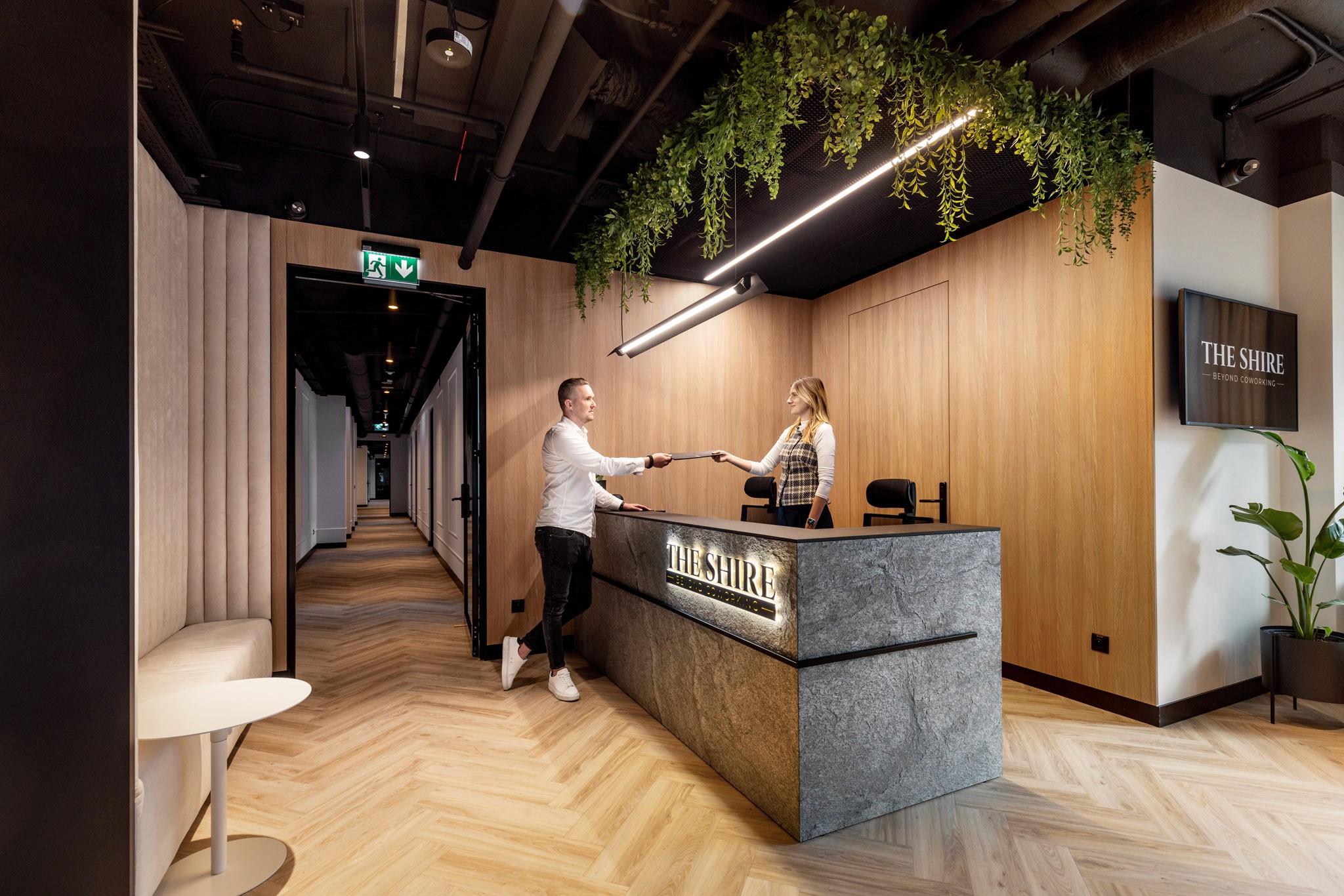
At The Shire, we understand that traditional lease agreements are often inflexible and expensive. That is why we build space capable of changing as a company changes. With configurable plans, you select the scope of space and services to match your current needs. When the team grows or the way you work changes, the arrangement adjusts - without relocations, refurbishments or rigid multi-year commitments.
In practice, we combine several formats into one flexible model. A company can use flexible coworking membership when it needs room for a few desks, then move into a private serviced office as the team expands. All of it in ready, fully equipped and serviced space, with high-speed internet, reliable equipment and comfortable shared zones - plus a community and a network of trusted partners supporting the company's growth.
Not sure what your company's needs will look like a year from now? That is exactly the situation in which the adaptive model works best. Get in touch and take a look at our locations. We will help you choose a space that grows along with your business.