Office acoustics - how to tackle noise and make use of acoustic booths


Office noise is one of those problems nobody reports directly - and one that steals hours of work every day. A conversation at the next desk, a colleague's phone call, the sound of the printer. Every such interruption breaks your concentration, and getting back into it takes longer than you might think. The good news is that acoustics can be designed and improved. One of the most effective tools available is the acoustic booth. Below we look at how to tackle office noise, and how to do it intelligently.
Acceptable noise levels in an office
For office work requiring concentration, the level considered comfortable is markedly lower than in a production hall. In practice the figures discussed are in the region of a few dozen decibels, rather than the threshold that protects hearing. Standards distinguish between the level that threatens health and the level that simply gets in the way of mental work. In an office, it is the second of these that is decisive. Put plainly: noise harmful to hearing is rarely the problem in an office. Almost always, the issue is noise that distracts.
Two perspectives need to be separated. The first is hearing protection. Standards define high levels above which noise threatens health, but a typical office practically never reaches them. The second, far more relevant to office work, is acoustic comfort - the level at which it is possible to concentrate on conceptual tasks. For work requiring concentration, markedly lower comfort figures are assumed than for simple tasks.
The type of work is what decides. Tasks requiring thought, analysis and attention are considerably more sensitive to noise than routine work. This is why, in an office full of specialists, even moderate background chatter can measurably reduce productivity - while remaining entirely safe from the point of view of hearing protection. The problem does not lie in absolute loudness. It lies in how the sound interferes with the specific work being done.
Detailed figures and measurement methods are governed by standards, and these are updated from time to time, so specific thresholds should be verified against current industry sources. For practical purposes, though, the key conclusion is this: in an office, the goal is not to stay within a hearing-protection standard. The goal is to create an environment in which people can concentrate - and that requires acoustics to be designed deliberately.
There is one more thing worth remembering. The subjective experience of noise often matters more than the measurement itself. The same sound level can be entirely neutral when it is steady - the quiet hum of ventilation, say - and highly distracting when it carries information, such as someone else's conversation that you involuntarily follow. Good acoustics is therefore not simply about lowering the decibel count. It is also about managing the type of sound: damping speech, eliminating sudden intrusive signals, and building a space in which noise does not carry across the whole room.
Five main sources of office noise
The most common sources of office noise are colleagues' conversations, phone calls and video conferences, office equipment, sounds from the building's surroundings, and the interior architecture itself, which reflects sound. Speech is the most distracting of these, because the brain processes it involuntarily. Understanding these sources is the first step to tackling noise effectively, since each calls for a slightly different solution.
The first and most significant source is people talking. Speech is particularly distracting because the brain automatically tries to understand it, even when nobody wants to listen. An intelligible conversation in the background therefore interferes more than a steady hum at similar volume. In open-plan space, where conversations are constant, this is the principal enemy of concentration.
The second source is phone calls and video conferences. These are louder and more one-sided than an ordinary conversation, and their sudden start breaks the rhythm of work. Where online meetings are the norm, the absence of dedicated places for such calls turns the whole space into a field of overlapping voices.
The third is office equipment: printers, air conditioning, kitchen appliances and audible alerts. The fourth is sound from the surroundings - street traffic, noise from corridors, neighbouring rooms or building works. The fifth, frequently overlooked, is the interior architecture itself. Hard surfaces, glass, concrete and an absence of sound-absorbing elements mean that noise bounces and carries across the whole space, amplifying every other source in the process.
The consequences of poor acoustics
Poor office acoustics reduce productivity, increase fatigue and stress, and worsen employee wellbeing. Over the longer term, this shows up in the quality of work and in engagement. Noise interferes with concentration, forces attention to be reset continually, and leaves a sense of exhaustion at the end of the day. It is a cost that appears on no invoice - and one the company genuinely bears.
The most direct consequence is a fall in productivity. Every break in concentration costs the time needed to return to the task. In conceptual work these losses accumulate. Instead of several hours of deep work, an employee gets a series of short, interrupted stretches, completing less and making more mistakes.
The second consequence is fatigue and stress. Working in noise requires constant, involuntary effort to filter out distracting sounds. That effort is tiring even when it goes unnoticed. The result is greater fatigue by the end of the day, higher stress levels and poorer wellbeing - which over time affects both motivation and health.
The third, longer-term consequence affects the whole organisation. Chronic acoustic discomfort lowers job satisfaction, can increase absence and turnover, and makes confidential conversations harder. When everything can be overheard, discretion is difficult. For a company this means real, if hidden, costs. Investing in good acoustics therefore repays itself in both comfort and results.
The costs of poor acoustics are diffuse and hard to spot, which makes them easy to dismiss. Nobody sends the company an invoice for hours lost to noise. Those losses are distributed quietly across the whole team, day after day. This is precisely why acoustics tends to be one of the last things considered when fitting out an office - even though it affects productivity as strongly as hardware or software. Companies that approach the workplace deliberately treat acoustic comfort on a par with ergonomics and technology. All three determine how much can actually be achieved in a given office.
How acoustic booths work and when to use them
An acoustic booth is a sound-absorbing, self-contained cabin in which you can take a phone call, join a video conference or focus on a task without disturbing others and without being disturbed by them. It is one of the most effective and most flexible acoustic solutions in a modern office. Booths solve precisely the problem that causes most difficulty in open-plan space: conversations and conference calls in an open environment.
The principle is simple. A booth is a small, soundproofed space with sound-absorbing materials, ventilation and usually somewhere to sit and connect equipment. It contains sound within, so a conversation does not distract the whole floor, while also cutting out external noise and providing somewhere to concentrate. It is an on-demand solution: you step in when you need quiet and release it when you are done.
Booths prove their worth in several typical situations: phone calls and video conferences; tasks requiring maximum concentration; short, confidential conversations; and as a safety valve in open-plan space when someone needs to shut out the background noise for a while. Their great advantage is flexibility. They require no rebuilding of the office and can be matched to the number of people and the way the team works.
It is worth remembering, though, that booths are part of the solution rather than the whole of it. The best results come from combining booths with an overall acoustic design: sound-absorbing materials, zoning of the space, and separating areas with different levels of quiet. A booth is excellent for conversations and quick focus, but the comfort of the whole space also depends on how it has been designed as a whole.
Beyond booths, office acoustics rests on several proven solutions. Sound-absorbing panels and ceilings absorb sound instead of letting it reflect. Soft materials - carpets, upholstered furniture, curtains - damp echo. Considered zoning separates loud areas, such as the kitchen or meeting zone, from quiet work areas. Added to this is sound masking: a gentle, steady background hum that makes individual conversations less intelligible and therefore less distracting. Good acoustics is always a combination of several such elements, selected for the particular space and way of working.
Acoustics in The Shire offices
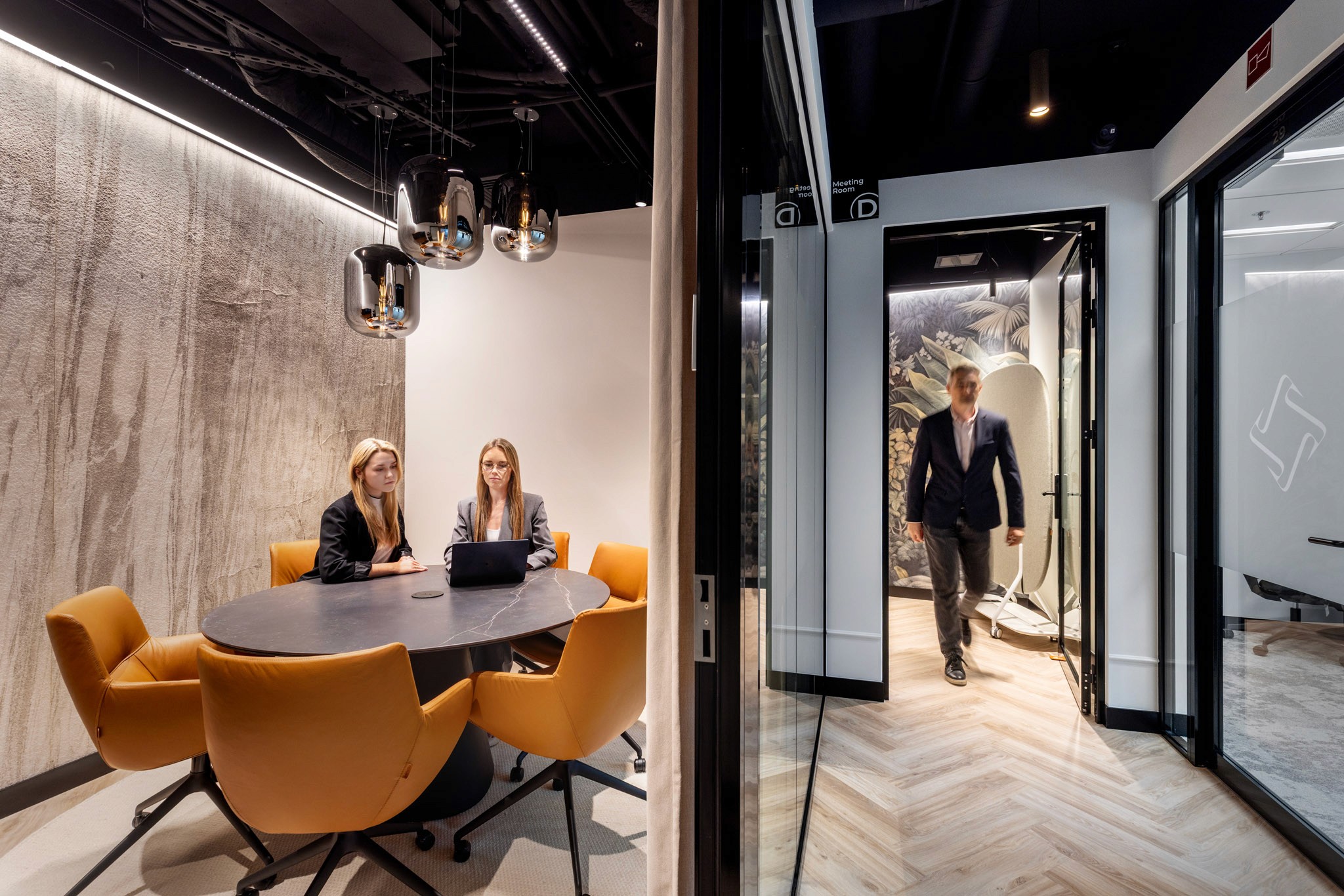
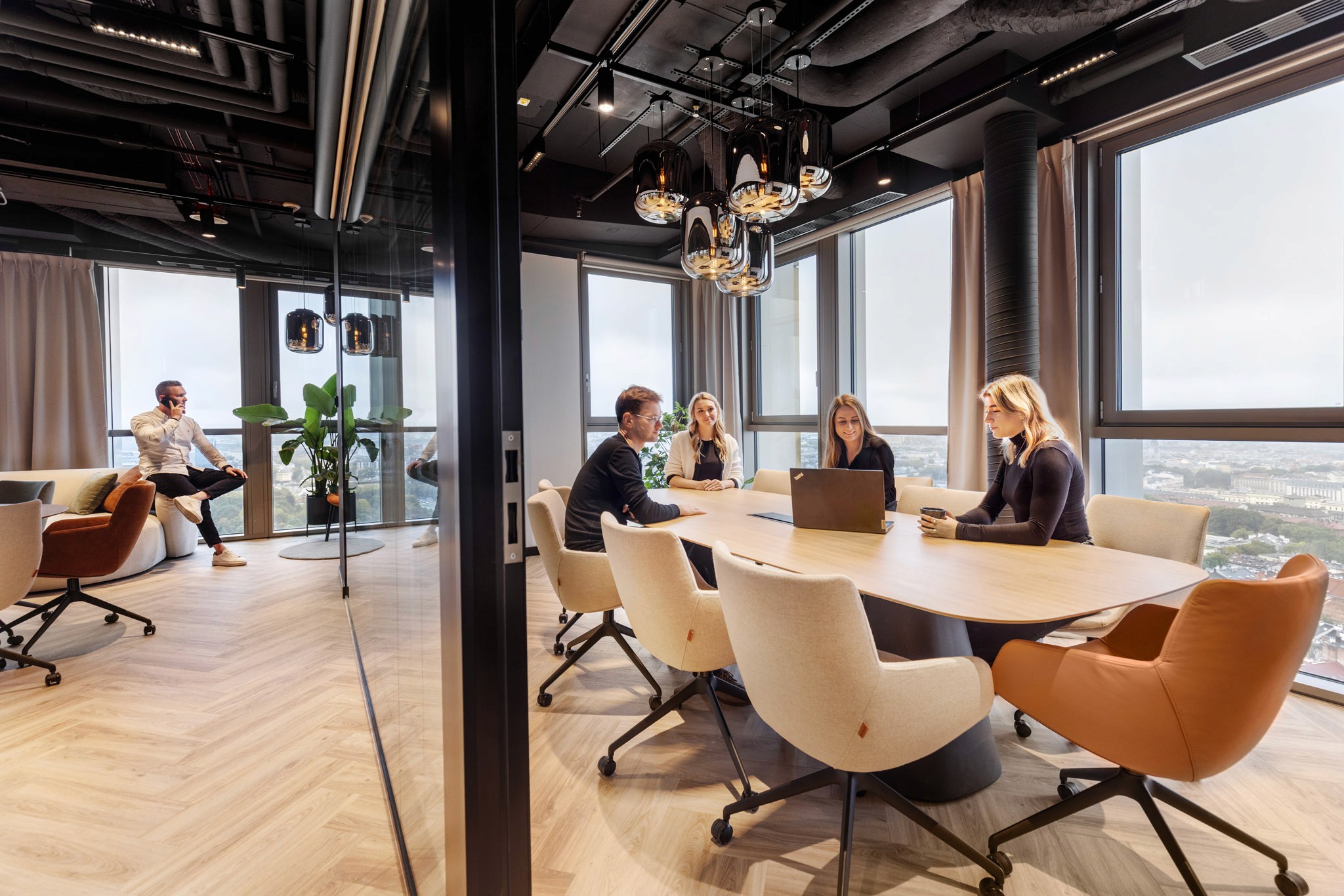
At The Shire, we design spaces with focused work in mind, and good acoustics is one of the pillars of that approach. We create places for people who value calm and effective collaboration. That is why we attend to aesthetics and to the invisible elements of comfort alike: soundproofing, sound-absorbing materials and a considered division into zones with different levels of quiet.
In practice this means a space where it is possible both to concentrate and to talk freely, without getting in each other's way. Dedicated quiet-work zones, places for conversation and solutions such as acoustic booths allow the environment to be matched to the task. A call or video conference can be taken without distracting others, and demanding work can be done in peace. It is a form of comfort that translates directly into productivity.
Is your company looking for an office that understands the value of quiet? Take a look at our coworking and flexible membership options, and at dedicated serviced offices for teams. Visit one of our locations or get in touch, and we will show you how we handle acoustics in practice.