Efficiency at work. How does an office affect productivity?


You can hire the best people, set them ambitious goals and give them good tools, and still lose several hours a day to something that appears in no report: a badly designed office. Noise, an uncomfortable chair, stuffy air, nowhere to work with focus. All of it quietly reduces the effectiveness of the whole team. There is good news, though. Workspace is one of the few levers of productivity over which you have real influence. This article shows how an office affects results - and what specifically to change so that people work better and more willingly.
What is efficiency at work and how do you measure it?
Efficiency at work is the relationship between the results achieved and what went into them - the time, energy and resources involved. It is not about working more hours. It is about delivering more value in the same time. It is measured with a set of indicators rather than a single number, and being busy has to be distinguished from an actual result. These are two different things.
In practice, efficiency combines several dimensions. The first is the result: projects completed, tasks delivered, the quality of the outcome. The second is the cost of achieving that result - how much time and energy it consumed. The third, frequently overlooked, is sustainability. Work at maximum intensity that leads to burnout is not efficient; its cost simply surfaces later.
Companies use various indicators for this: goal completion and timeliness, quality and the number of revisions, employee turnover and engagement levels. Hard data is worth combining with soft. Hard data tells you what was produced and how quickly. Soft data shows how people rate their conditions and workload. Overtime alone is a poor measure - it tends to signal an organisational problem rather than high productivity.
For a business owner or HR manager, one further conclusion matters. Efficiency depends not only on people's competence and motivation, but also on the environment in which they work. That part of the equation is easy to overlook - and it is precisely the part you can influence fastest, through the choice and organisation of an office.
Efficiency and employee wellbeing are not competing goals; they are two sides of the same coin. A team that is tired, stressed and working in poor conditions loses productivity sooner or later. It makes more mistakes and falls ill more often. Turnover rises. Good measurement of efficiency therefore also takes account of warning signals: absence levels, engagement, satisfaction with working conditions. A company that looks only at short-term results and ignores people's wellbeing usually pays for it later, in higher recruitment costs and lower quality of work.
Five office elements with the greatest effect on productivity
Five things affect productivity in an office most strongly: acoustics and noise levels, workstation ergonomics, air quality and lighting, access to zones with different purposes, and the overall comfort and aesthetics of the space. These determine whether an employee concentrates on the task or fights their surroundings. Each element on its own looks like a detail. Together they make the difference between an office that helps and one that gets in the way.
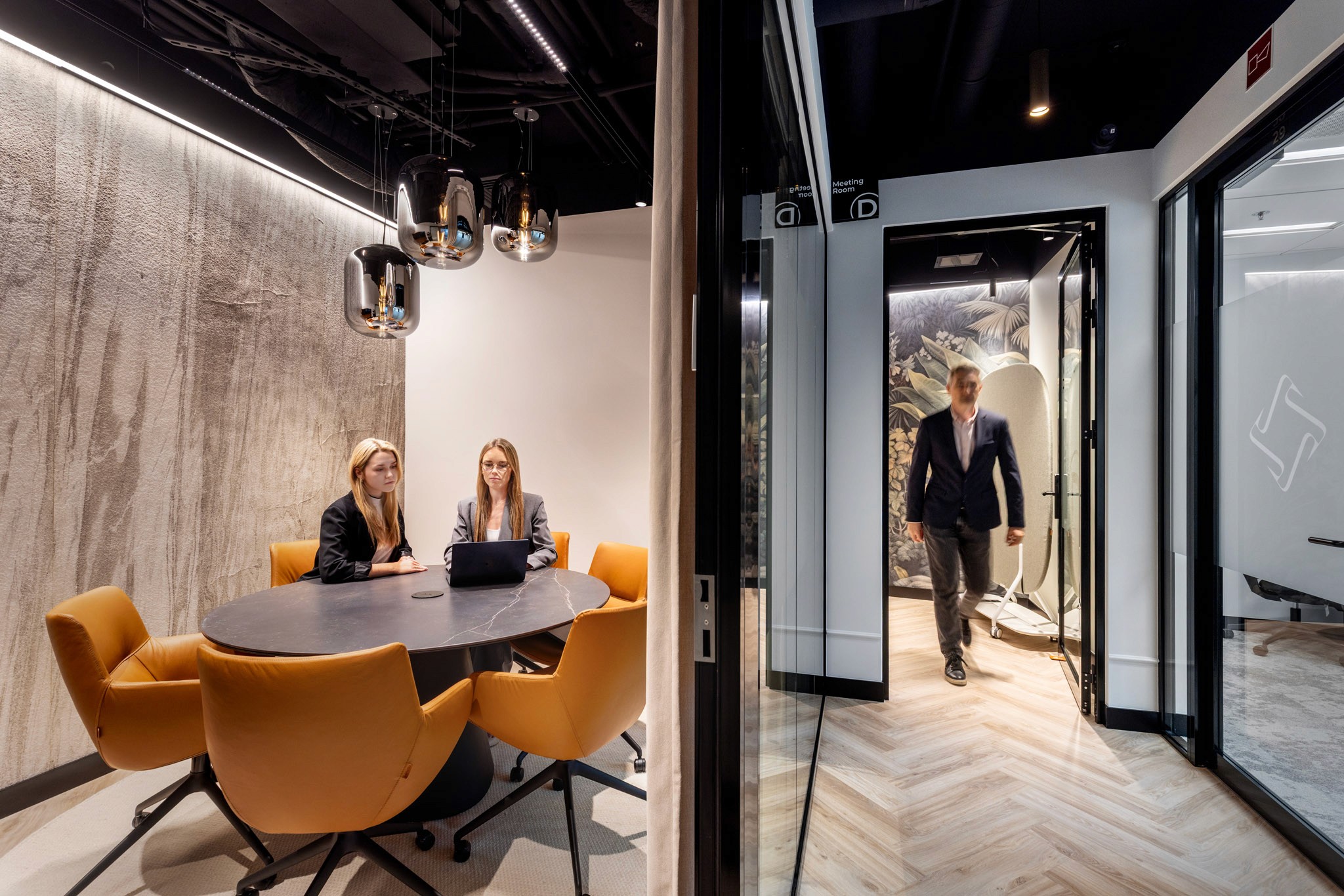
The first element is acoustics. Noise and incidental conversations are among the chief enemies of concentration. Every interruption costs, and returning to deep focus takes considerable time. An office that provides quiet where it is needed genuinely raises productivity - through quiet-work zones, phone booths and meeting rooms.
The second is ergonomics. A comfortable adjustable chair, a desk at the right height, a monitor at eye level. This is not luxury; it is the condition for your body not to drain energy and attention after a few hours of work. A poor workstation means pain, fatigue and micro-breaks, and these add up to lost hours and sick leave.
The third element is air and light. A stuffy, overheated room with carbon dioxide above acceptable levels induces drowsiness and reduces the capacity to think. Poor lighting tires the eyes and lowers mood. Access to daylight and good ventilation are among the simplest ways to maintain energy throughout the day.
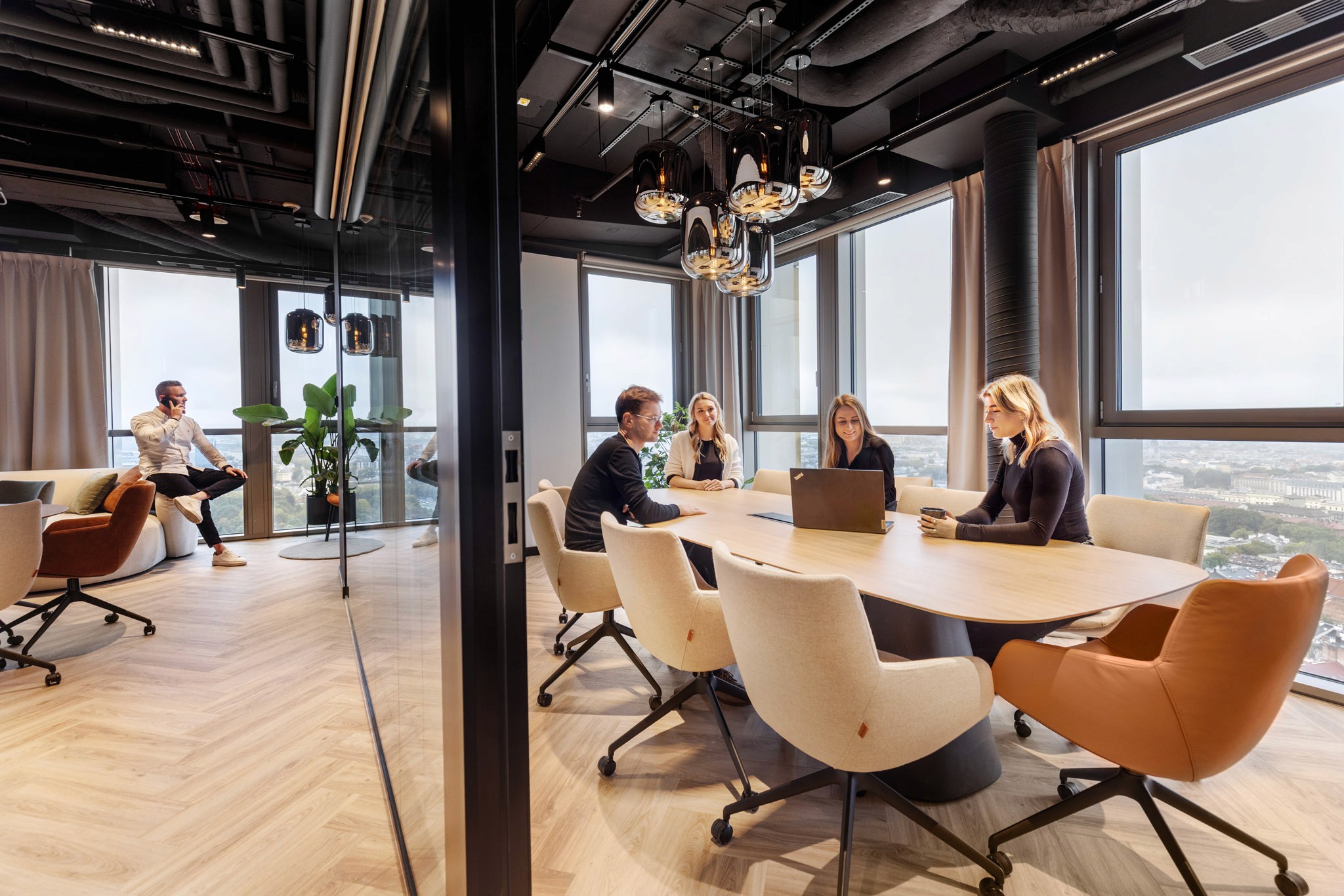
The fourth element is varied zones. Over the course of a day, the same employee needs quiet for analysis at one moment, somewhere to talk to a client at another, and space to work with the team at a third. An office offering only one type of space forces everyone to perform very different tasks in the same averaged conditions. Access to zones with different purposes allows the environment to be matched to the task, which translates directly into the pace and quality of work.
The fifth element is comfort and aesthetics. A pleasant, well-kept space that is good to be in affects how people feel, and through that their engagement and productivity. This is not about striking decor for its own sake. It is that people come in more willingly, sustain their energy longer, and identify more with a place designed with them in mind. This element cannot be captured in a single number, but you can feel it in the daily atmosphere of work.
How to increase efficiency at work
Efficiency is raised along two tracks: by organising the way work is done, and by improving the environment in which it happens. Provide conditions for concentration, reduce the number of interruptions, ensure ergonomic workstations, and let people match their workplace to the type of task. The best results come from combining organisational change with investment in the space. One without the other is usually not enough.
Start by protecting time for deep work. Tasks requiring concentration need uninterrupted blocks of time and quiet surroundings. It is worth introducing rules about meetings, notifications and availability - while also providing physical quiet zones where nobody disturbs anyone. A focus policy without anywhere to put it into practice remains on paper.
The second area is matching place to task. A client conversation needs different conditions from a team workshop, and different again from solo analysis. A space with varied zones lets people choose their surroundings instead of squeezing every task into the same desk. This means zones for quiet work, meetings, creative collaboration and rest.
The third area is ergonomics and recovery. Provide good chairs, desks and equipment - but also real breaks. A short reset in a comfortable relaxation zone translates into better attention in the hours that follow. Contrary to appearances, breaks do not reduce productivity; they sustain it. Human attention works in cycles, and after a period of intensive work it needs recovery, or quality falls regardless of the number of hours worked. Added to this are tools and reliable infrastructure: high-speed internet and equipment that works. Nothing lowers efficiency quite like technology that fails at the least convenient moment.
The final area is talking to the team. People know best what slows them down. Regular feedback about working conditions is one of the cheapest sources of improvement, and sometimes the obstacle turns out to be something invisible from board level: a zone that is too loud, nowhere to take a call in peace, or meeting rooms that are always fully booked. Listening to these signals and responding quickly produces results out of all proportion to the cost - and builds a sense that the company genuinely cares about working conditions.
Type of office and efficiency at work
The office model genuinely affects productivity. A traditional lease, home office, coworking or a serviced office - each resolves the questions of focus, comfort and infrastructure differently. There is no single best solution. There is a solution matched to how the team works. The model is worth choosing deliberately, rather than persisting with whichever one you happened to inherit.
Fully remote work provides quiet and no commuting. For many people, however, it lowers efficiency, because of domestic distractions, poorer ergonomics and the blurring of the boundary between work and life. A home office works well for tasks requiring solo concentration, less well for teamwork and building relationships. It can also be a source of isolation, which in time hits engagement.
A traditional office gives control and shared space. It comes, however, with a long, rigid agreement, the costs of equipping and maintaining it, and the risk that the space fails to keep up with changes in the team. Its quality depends entirely on how much the company invests in fit-out and upkeep - and not everyone has the time and budget for that.
Coworking and serviced offices shift the burden of organising space onto the operator. The company gets a ready, professionally designed environment, with ergonomics, acoustics, zones for different purposes and reliable infrastructure, without having to build it all itself. For many companies this is the fastest route to conditions that support productivity - and one that is flexible in cost. A serviced office additionally provides private, dedicated space for the team, combining the comfort of your own office with the convenience of a ready-made solution.
The Shire premium workspace - how we design offices for efficiency
At The Shire, we create spaces that combine prestige with comfort, designed for people who value calm, aesthetics and effective collaboration. Our offices are designed to support concentration and wellbeing. High-speed internet, reliable equipment, comfortable relaxation zones and good coffee - these are the elements that let people work with full focus and enjoyment.
We build environments that genuinely raise productivity. Varied zones for focused work, meetings and rest allow the place to be matched to the task. Attention to comfort, light and aesthetics translates into the team's energy throughout the day. As a result, people are not fighting their surroundings; they have conditions in which good results come more easily.
Added to this is flexibility. We understand that traditional lease agreements can be inflexible and expensive. That is why we offer configurable arrangements, from a place in coworking to a dedicated serviced office for a whole team. A company chooses the scope that suits its needs and budget, and scales it as it grows.
Your team deserves space designed for efficiency. Get in touch and we will show you how to match a The Shire office to the way your company works.