Expanding into a new city - the serviced office as a market entry tool



The decision to enter a new city is usually taken quickly. A client appears, or an opportunity, or a good labour market. The difficulty starts afterwards, with the question of where exactly to open the branch. The classic answer is a long lease, a refurbishment and months of organisation before anyone starts working. A growing number of companies, however, choose a different route: a serviced office that allows you to enter a new market within days, test it, and scale without freezing capital. This article explains why that works and how to make use of it.
Why is expanding into a new city difficult?
Expanding into a new city is difficult because the company arrives without the support base it has on its home market - without knowledge of local conditions, without a team on the ground, and without ready infrastructure. Added to this is financial risk: the costs have to be borne before the new market starts earning. This combination of uncertainty and high up-front outlay is why many companies postpone expansion or pursue it more slowly than they could.
The first challenge is uncertainty of demand. Before a company can establish whether there is genuinely a market for its product or service in the new city, it has already had to invest in something - in a presence, in people, in a place. If the market proves weaker than assumed, part of that outlay is lost. The risk stings particularly under rigid, long-term commitments.
The second is resources and management attention. Expansion consumes time and energy that are usually in short supply, because the existing business has to be run in parallel. Setting up an office, recruiting, dealing with formalities and logistics in an unfamiliar city easily stretch into weeks and months, pulling the team away from work that generates revenue.
The third challenge is local credibility. On a new market the company is anonymous. It has no track record there, no references and no recognisable address. Clients and partners trust a company with a real, professional presence in the city more readily than one operating remotely from head office. Building that credibility from scratch takes time, which rapid expansion usually does not allow.
There is also a staffing challenge. Entering a new market often means recruiting local employees. It is hard to attract good people without somewhere for them to work and without a recognisable employer brand in that city. Candidates assess the offer, but also what the future workplace looks like and where it is. Professional, well-located space from day one makes recruitment easier and builds the image of a stable, credible employer - even when the company is only just entering the market.
Traditional lease versus serviced office when expanding
When entering a new market, a traditional lease and a serviced office differ above all in speed, flexibility and risk. A traditional lease means a long agreement, investment in equipment and weeks of preparation. A serviced office is ready space you can move into immediately, paying flexibly for what you use. In expansion, where time and limiting risk are what count, this difference can be decisive.
A traditional lease ties a company down for years. Added to it are the costs of fit-out, furniture, equipment and infrastructure, along with the time all of this takes. Weeks or months pass before anyone sits down to work. If, after a year, the market turns out to look different from the assumptions, exiting such an agreement is expensive and complicated. It is a model that rewards certainty, not testing.
A serviced office reverses this logic. What you get is fully ready, equipped and serviced space, with internet, furniture, reception and maintenance included in the price. You can move in almost immediately. Agreements are flexible, and the amount of space can be matched to the number of people you actually have on the ground. Instead of a large investment at the outset, you bear a predictable monthly cost.
For expansion, it is precisely this flexibility and speed that matter. A serviced office lets you enter a market, test it and - depending on results - quickly increase your space or withdraw, without freezing capital in a long agreement. That turns expansion from one large, risky decision into a series of smaller, reversible steps.
This does not mean a traditional lease is always the worse option. It makes sense where a company is already certain about the market, plans a presence lasting many years and expects a large, stable headcount. At the right scale it can be cheaper per workstation. The point is that when entering a new market, certainty is usually absent - and that is precisely when flexibility is worth more than optimising unit cost. A serviced office therefore works best as a tool for the entry and testing phase. It lets you start quickly and take the decision about a permanent model later, on the basis of real market data rather than assumptions.
Barriers to entering a new market
On arriving in a new city, a company encounters financial, organisational and reputational barriers. These are what most often slow or block expansion. A serviced office lowers most of them: it removes the start-up cost, shortens the time to launch, and provides a professional address from day one. Understanding these barriers helps in deliberately choosing an entry model that minimises them.
The financial barrier is the cost of entry: deposits, fit-out, equipment and monthly obligations that have to be carried before the market starts repaying the outlay. The higher the entry threshold, the greater the risk and the more cautious the decisions. A model in which you pay a flexible monthly subscription for ready space lowers that threshold considerably and makes planning more realistic.
The organisational barrier is the whole workload required simply to make working in a new city possible - from finding premises, through supplier agreements, to buying furniture and equipment. Each of these steps consumes the time of a team that should be building sales rather than dealing with logistics. A ready serviced office lifts this burden, because the infrastructure and services are already in place.
The reputational and relational barrier is the absence of local recognition and contacts. On a new market, trust and a network of relationships have to be built from the ground up. A prestigious address helps here, but so does a presence somewhere with its own business community and partners. This provides faster access to local contacts, services and potential clients than a company would build on its own.
These barriers reinforce one another. A high cost of entry increases the pressure for quick results, while the lack of a support base and contacts means those results come more slowly. This vicious circle is one of the main reasons expansions are put on hold or end in disappointment. A model that simultaneously lowers start-up costs, shortens the time to launch and provides access to a local support base defuses several barriers at once. This is exactly why a serviced office fits so well into a new market entry strategy.
Warsaw, Kraków, Wrocław - which city to choose?
The choice of city for expansion should follow from the specific market and the company's goals, not from a size ranking alone. Warsaw, Kraków and Wrocław are the three strongest business markets in Poland, but each has a different character and attracts somewhat different companies and talent. A good decision combines market potential with the availability of employees and proximity to clients.
Warsaw is the largest and most diverse market in the country - a centre of finance, corporations, public administration and international business. It is the natural direction when a company wants access to large clients, capital and the widest talent pool. The price for that potential tends to be greater competition and higher costs, which is why a flexible entry allows the market to be tested without excessive risk.
Kraków is a strong centre for modern business services, technology and startups. It has a large base of qualified, often multilingual employees and an academic character. Companies choose it partly for access to IT talent and the business services sector, along with lower costs than in the capital while retaining a high quality of staff.
Wrocław combines a strong economy, technology and industrial sectors, and a convenient position in western Poland, close to the German and Czech markets. This makes it attractive for expansion aimed at Western Europe. It is also a strong academic centre with a large inflow of young specialists, which makes building a team easier. Each of these three cities therefore offers something different, so rather than following fashion it is worth setting their profiles against your own business model.
Instead of looking for one best city, it is worth asking a few questions. Where are the clients? Where will the right employees come from? Which market best suits the company's model? A flexible serviced office also allows the choice to be treated as a test: you can enter one city, review the results and consider the next, using the same proven model.
The Shire as an expansion partner
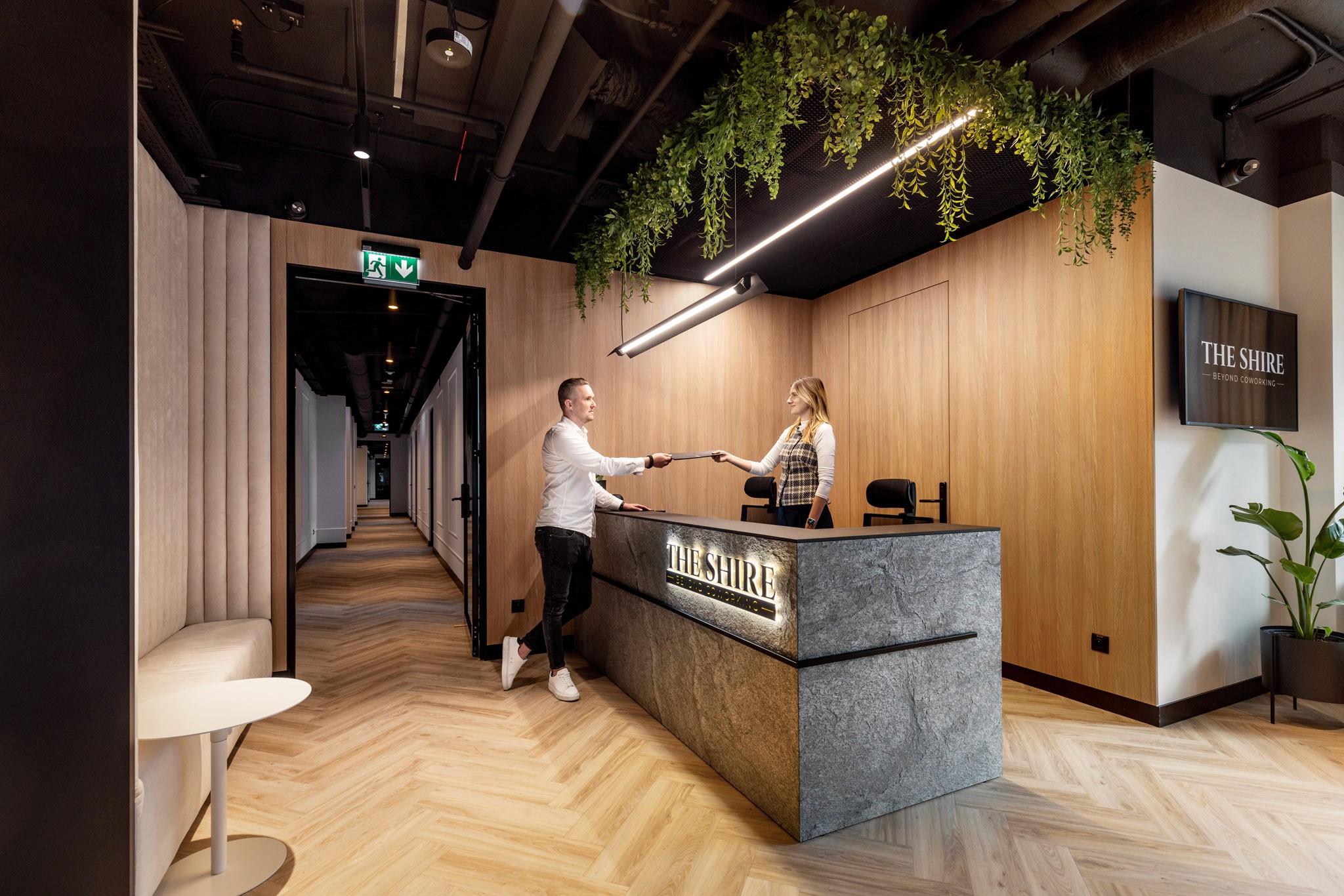
At The Shire, we help companies enter new markets faster and with less risk. We offer ready, fully serviced offices in prestigious locations. Instead of a long agreement, a refurbishment and months of organisation, we provide space in which your team can start working almost immediately - with high-speed internet, reliable equipment, comfortable relaxation zones and a professional address from day one.
Our flexibility is the greatest advantage here. We understand that scale is hard to predict in advance during an expansion. With us, therefore, the space is matched to the number of people you actually have on the ground, and expanded when the market proves promising - without freezing capital in a rigid agreement. This lets you treat entering a new market as a series of sensible, reversible steps.
Added to this are a community and a network of trusted partners in areas such as finance, legal, HR, recruitment and IT, together with a presence in the most important cities: Warsaw, Kraków and Wrocław, joined by Gdynia in September 2026 and Poznań in October. As a result, a company enters a new market not alone, but with a local support base and contacts that make the start easier. Planning an expansion into a new city? Get in touch. We will help you plan your entry and choose an office matched to your goals.