Hybrid Work - How to Organise an Office in a Hybrid Model



Hybrid work is no longer an experiment. It is the standard in most knowledge-based companies. The question is no longer "whether", but "how to organise it so that it works for the team and for the finances". An office space designed for 100 per cent attendance runs half-empty and costs the same.
In short:
Hybrid work combines remote work with office presence (usually 2–3 days a week).
The classic 1:1 office (one desk per person) becomes inefficient. It generates 40–50 per cent emptiness.
Hot desking, meeting rooms, and good video-conferencing equipment are the foundation of a hybrid office.
Coworking and serviced offices are a natural fit for this model.
What is hybrid work and why is it gaining popularity?
Hybrid work is a model in which the employee divides working time between the office and a remote location. Most often their own home. The most common arrangement is 2–3 days in the office and 2–3 days from home, agreed flexibly or on a fixed cycle. The pros and cons of hybrid work are today weighed for most companies in favour of this model. It allows team efficiency to be maintained while responding to the expectations of employees who do not want to return to full office presence.
The hybrid model is not just a concession to preferences. It has a hard, financial dimension. In terms of office space, it means the company does not need space "for maximum occupancy", but for a realistic average day. The difference is often 30–40 per cent fewer square metres. Proportionally lower rent, lower operating costs, and a lower carbon footprint.
For employees, the value of the model comes down to three things. Shorter commute times. Better concentration during focused work (from home). Maintaining team contact (in the office). These three elements together provide something that neither full remote work nor full office presence delivers.
How to adapt office space to hybrid work?
A hybrid office is not a smaller version of a traditional office. It is organised differently. The classic 1:1 layout (one desk per person) generates 40–50 per cent emptiness in a typical hybrid week. An office for hybrid work must be designed for the real dynamics of attendance.
Four principles for organising a hybrid office:
1. Fewer desks, more zones. Instead of 100 desks for 100 people: 60 desks + a focus zone + meeting rooms + phone booths + a kitchen area.
2. Booking instead of assignment. A booking system in which the employee reserves a spot for a given day. Eliminates conflicts and provides visibility of occupancy.
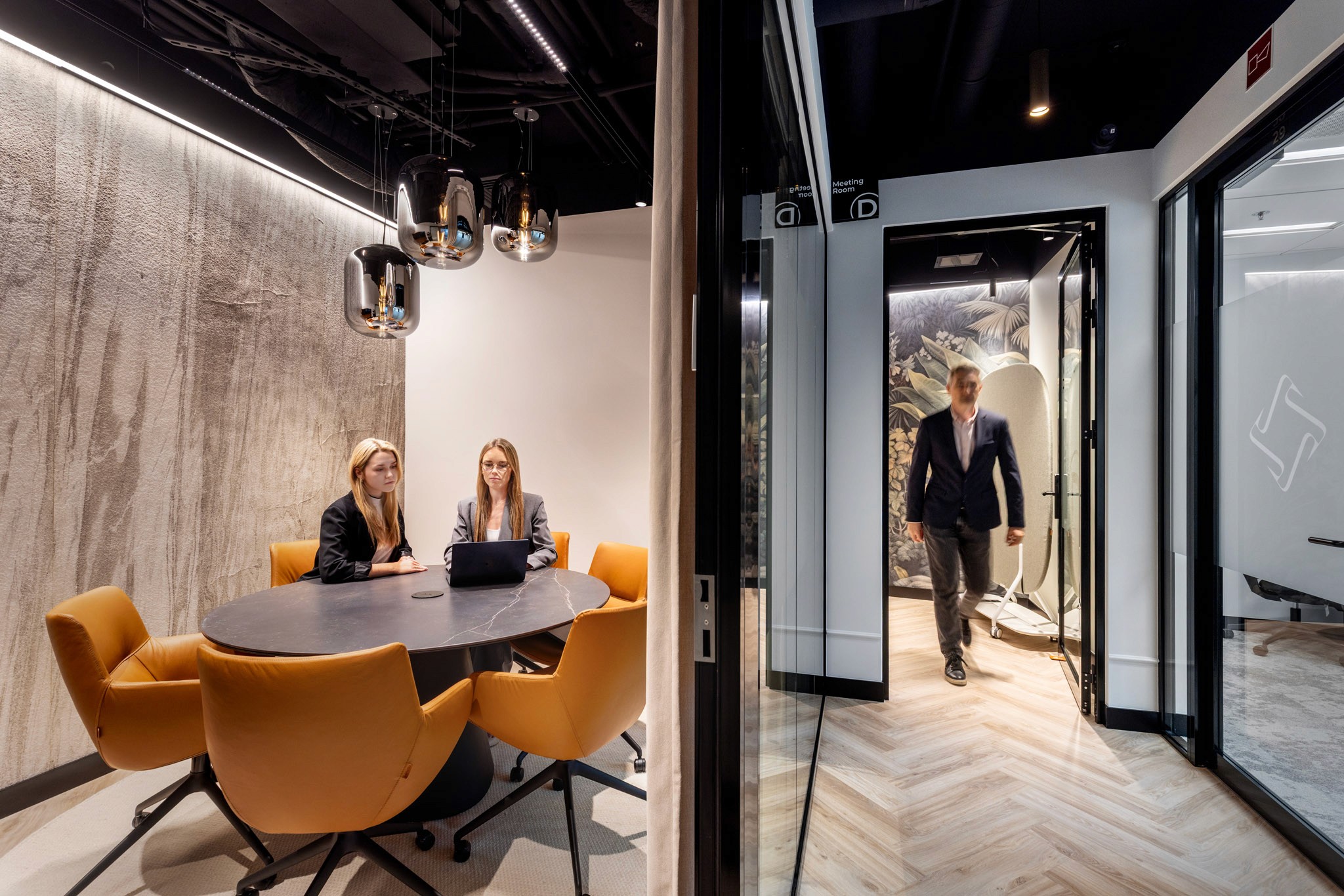
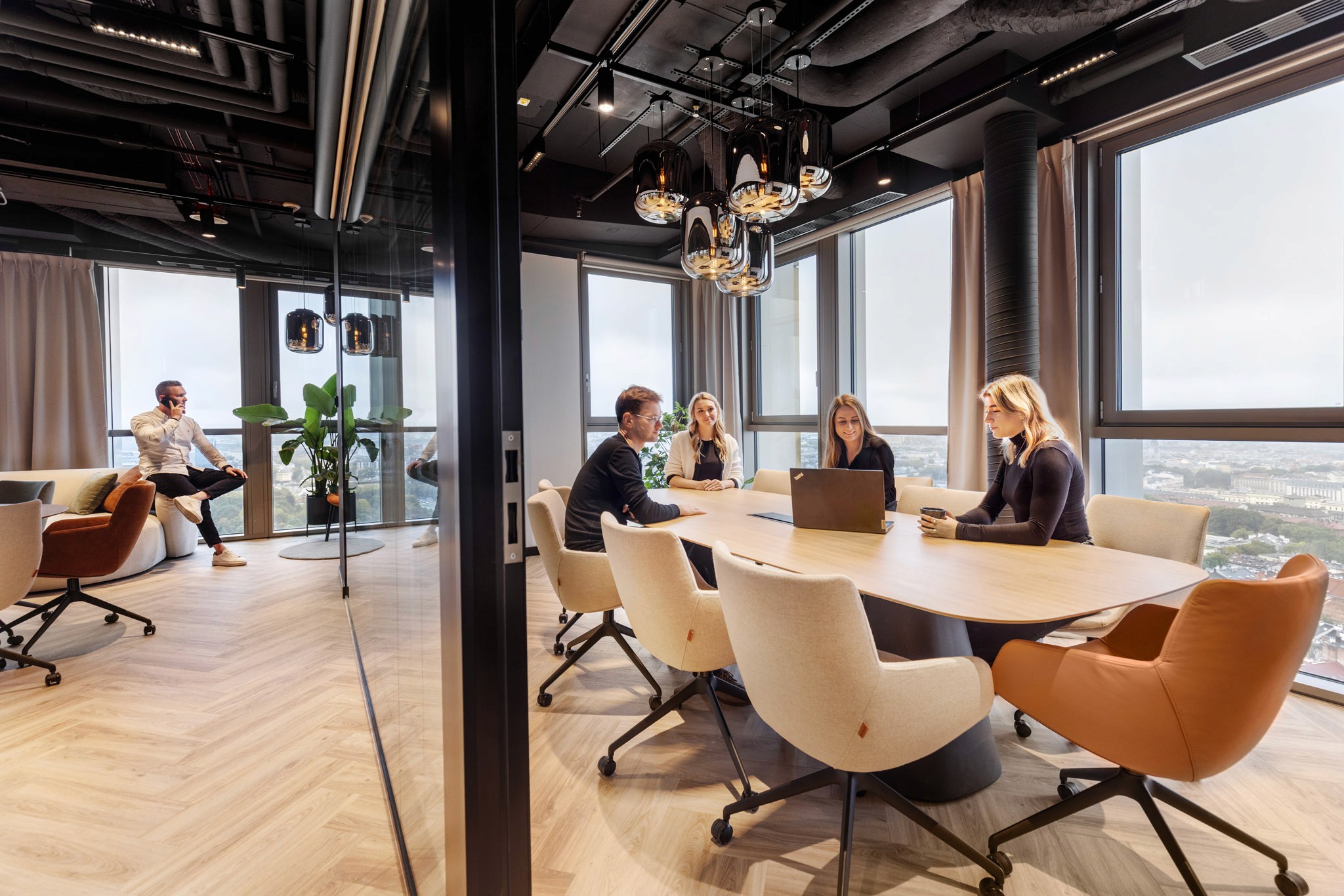
3. Hybrid-equipped meeting rooms. Every room above 4 people should have a camera, microphones, and a screen for video calls. At least half of meetings in a hybrid model involve someone remote.
4. Differentiation of workstation types. Working in the office has a different purpose from working from home. People come to talk, collaborate, and run workshops. Open zones then matter more than rows of desks.
Hot desking as the foundation of a hybrid office
Hot desking in hybrid work is not an extravagance, but a logical consequence. Since no one is in the office five out of five days, assigning a desk to a person is wasted space.
In practice it looks like this. The employee books a desk for the day they come in (in the app or on site). Takes the spot. In the evening leaves a clean workstation. The next day another team member can take exactly the same spot.
Organising a hybrid office with hot desking requires two additional elements:
Lockers for personal items and equipment not worth carrying in a backpack every day.
Workstation standardisation. Each desk has a similar set (monitor, dock, cables) so that every person can sit down and work in 60 seconds.
Well-implemented hot desking allows 100 people to be served in 60–70 workstations, which in a 3/2 hybrid model means full capacity.
Serviced offices and coworking in the hybrid model
Coworking and hybrid work is a combination that has become obvious in recent years. Many companies, however, still maintain a traditional lease "because that's how it has always been". Meanwhile, a serviced office in a hybrid model is precisely the scenario in which the flexible format shows the full extent of its value.
Coworking works where the team is small (up to 10–15 people) or strongly distributed. Each team member has access to any of the operator's locations, regardless of city. Pricing per person, no fixed space costs.
Serviced office is a variant for teams that need their own private room but do not want to deal with layout, IT, and support. Privacy is preserved (a closed room), while the shared infrastructure (reception, meeting rooms, kitchen, events) is used.
Both formats share one key feature: scalability. The team grows, the room changes. The team shrinks, the space is reduced. No five-year contracts typical of a traditional lease.
When planning coworking for a hybrid team in Poland's largest cities, the list of locations below will be helpful:
If the team needs a private room with full support, it is worth considering a serviced office:
Challenges of hybrid work and how to address them
The challenges of hybrid work are real and do not disappear simply by introducing the model. The three most common:
Asymmetry in meetings. People in the office talk to each other; remote participants are "an image on the wall". Solution: every room above 4 people equipped with a wide-angle camera and good microphones. Plus the rule "one remote participant = everyone turns on their laptops with separate cameras".
Decreased visibility of those less present in the office. People working mainly remotely lose visibility in promotions and decisions. Solution: consciously scheduling regular "everyone in the office" days and a structure of 1:1 meetings independent of physical presence.
Difficulty in onboarding new people. A new employee without face-to-face contact with the team needs 3–4 times more time to come up to speed. Solution: the first 4 weeks in the office, a dedicated buddy, intensive 1:1 sessions.
Well-managed hybrid work gives the company the best of two worlds. Poorly managed, it creates a divided, disengaged team that is less effective than one fully remote or fully office-based.
Hybrid work requires rethinking space and processes. Not just permission to "have 2 days from home". The office stops being a place where you sit. It becomes a place where you meet.
If you are wondering how to match space to your team's hybrid rhythm, get in touch. At The Shire we will help design a model matched to your real occupancy and way of working together.